Sunday, March 13, 2016

Machine Learning in Healthcare

I attended a technical symposium yesterday hosted by the CIE-USA (Chinese Institute of Engineers-USA). One of the most popular plenary presentation was delivered by Dr. Jianying Hu (a Distinguished Research Staff Member and Senior Manger of Health Informatics Research at IBM T. J. Watson Research Center, NY) about "Data Driven Healthcare Analytics". Her team leveraged the data existing in the healthcare ecosystem, and developed various machine learning-based tools to help players such as doctors and medical directors in this ecosystem to make better decisions in care delivery and care management. For example, the Care Pathway Explorer is a system that mines and visualizes a set of frequent event sequences from patient EMR (Electronic Medical Records) data. The data of more than 200,000 patients over three years time frame has been analyzed in her research. 
Overview of the Care Pathway Explorer system: It contains four major modules: Event Database, Data Preprocessor, Frequent Pattern Analytics, and a Visual Interface.
"The goal is to utilize historical EMR data to extract common sequences of medical events such as diagnoses and treatments, and investigate how these sequences correlate with patient outcome." Patient similarity has been extracted through machine learning techniques to help decision making process. 
Care Pathway Explorer: A bubble chart and displays events of the most frequent patterns mined (left), and a flow visualization to show the most frequent patterns (right).
Insights of Care Pathway Explorer: Examples of insights reached interactively when mining patterns from patients with a hypertension pre-condition before the initial hyperlipidemi a diagnosis (2,800 patients, featuring 14,979 hyperlipidemia-related diagnoses and 24,898 medication events).
Machine learning has been integrated into the healthcare process and is ready for commercial deployment. I was so impressed to see how this new technology has started impacting the healthcare system. Though the speaker insisted that the system will only be a powerful tool for doctors to improve their efficiency, there were lots of feedback and comments about its potential to dramatically change (or even replace) doctors' roles in the healthcare system in the years to come.

I found a YouTube video and a paper in technical journal include the similar information shared by Dr. Jianying Hu yesterday. If you are interested in this field, you should take a look. Besides healthcare, machine learning has potential to change many other aspects of our lives. It encourages me to spend more time to catch up this fast-growing technology.

Thursday, January 14, 2016

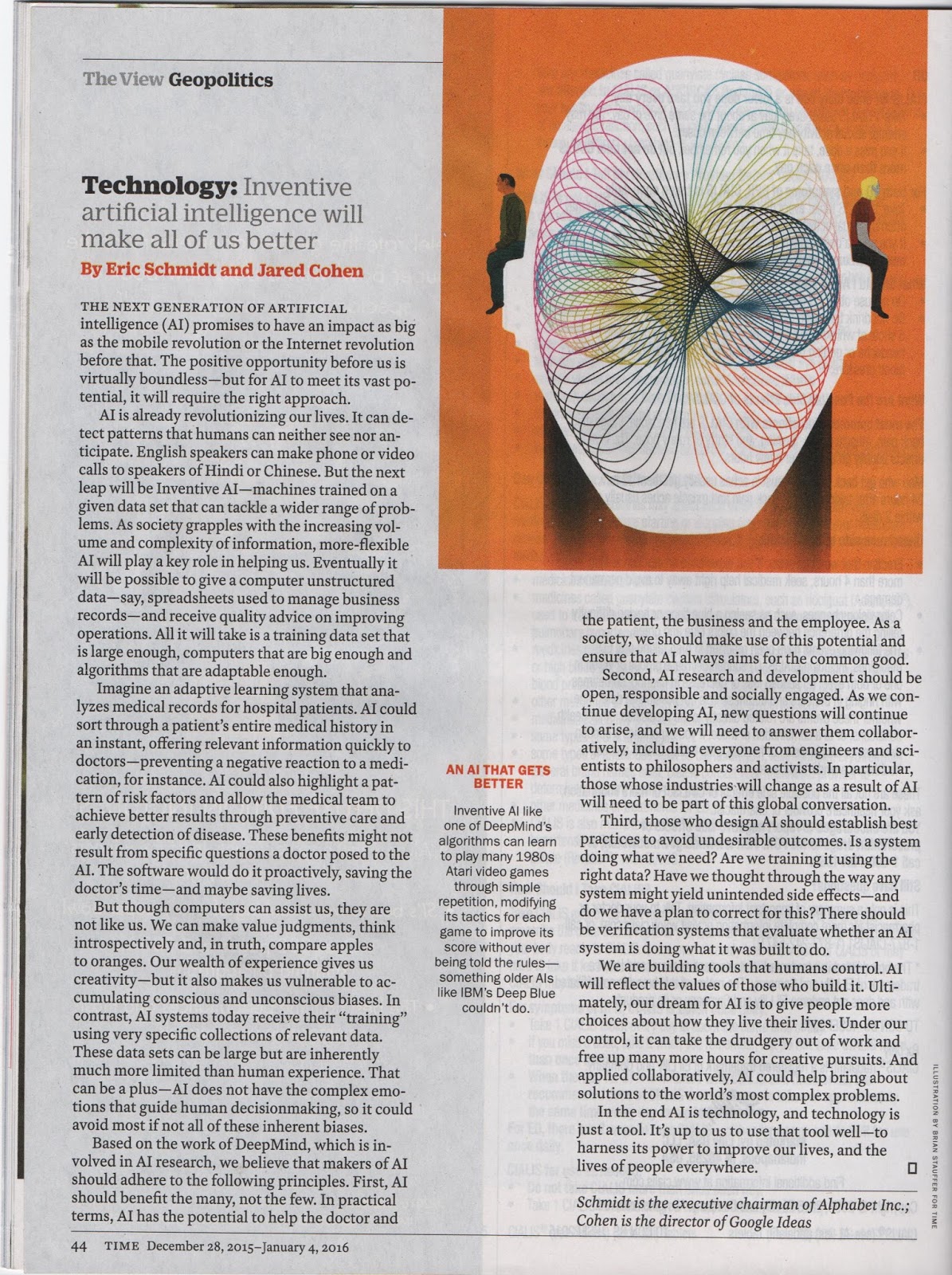
Here is an article I found in my Time Magazine about AI
December 24, 2015-January 4, 2016
Pg. 44

Progress Presentation

Here is my progress presentation.

Monday, January 4, 2016

Perceptron Algorithm Notes

Introduction

  • Perceptron models a neuron
  • n inputs are received by it that correspond to features
  • It takes the inputs and sums them, then produces an output after checking the result
  • Its main use is to classify groups that are linearly separable
  • It is often used for binary classification
Components
  • It is composed of a summation processor, and activation function (does the thresholding) and weights.
  • It takes a weighted sum of the inputs and outputs 
    • e.g. 1 if the sum is greater than the threshold and 0 if it isn't
    • Usually the input and output weights are real numbers
  • Perceptron can also have an input called the bias
    • Bias allows the transfer function curve to be shifted horizontally along the input axis while the curve is left unaltered.
  • Weight determines the slope 
    • e.g. in the eq. y = mx + b, m is the weight and b is the bias
  • Activation Function
    • Also know as transfer function
    • It translates input signals into output signals 
    • The output is produced using a threshold
    • The 4 types of activation functions most commonly used are: Unit step, sigmoid, piecewise linear, and Gaussian
      • The unit step is a simple threshold where the output is 1 of 2 levels and it depends on whether the input is greater than or less than the threshold value
      • The sigmoid contains 2 functions: tangential and logistic. Values of tangential functions are from -1 to 1 and the values of logistic functions are from 0 to 1.
      • In the piecewise linear function the output arrived at from being proportional to the total weighted output.
      • The Gaussian functions are continuous bell shaped curved functions. The node output which is high or low is interpreted from class membership which is 1 or 0, and depends on how close the net input is to a chosen value or average. 
  • Learning Rate
    • Used when updating the weights and bias to get a smaller error
    • Helps control how much the weights and bias are changed
  • Learning In Perceptrons 
    • when trying to find a line to separate two classes or groups it responds to the input vectors with a target value of 0 or 1
    • If the classes can be separated the solution will be found in a finite amount of time.

Thursday, December 31, 2015

Happy New Year!

Happy New Year! How was your winter break so far? Have you got some fun and got the chance to look into our first project? I just finished my first phase of study in Artificial Neural Network (ANN), and here is my note in PowerPoint form. You can use it to help you understand the basics. My next phase is to work on the Perceptron. If you had made some progress, feel free to share with us by posting your results in the blog. We will find time to meet as a group in the new year.

Wednesday, December 30, 2015

Ted Talk (implications of computers that can learn):

 Arthur Samuel was the “father” of machine learning because in 1956 he wanted to get a computer to beat him at checkers. He had computer play against itself and learn through thousands of times. In the end it worked.

 There is such a thing as a machine learning practitioner. Google shows it is possible to find information using a computer algorithm. This algorithm uses machine learning. Amazon, netflix use machine learning to suggest products. Rather than being programed by hand, algorithms learned how to do this from data.

 Self driving cars are possible because of machine learning. The self driving car has driven a million miles without any accident. Deep learning is an algorithm inspired by how the human brain works. Theoretically, there are no limitations to what it can do. The more data and computation time it has, the better it gets.

 Computers can listen and understand. They can also see. There is a 6 percent error rate in image recognition in computers. More complex sentences are understandable because of deep learning. Nuanced sentences are understandable. Computers can recognize what sentences are about. Computers can also write. They can describe images without having seen them in that order before. Deep learning can cut a lot of time from tasks.

Thursday, December 10, 2015

Machine Learning Project 1: Perceptron

In our first task, we are going to learn and implement a basic neural network - "perceptron". In machine learning, the perceptron is an algorithm for supervised learning. It is a type of linear classifier which can classify linearly separable data. The following links give you a starting point to study perceptron. You are more than welcome to share any resource you found online with us.

Tutorials:
Goals:
  • Understand the basic operation of Perceptron
  • Backpropagation
  • Learning rules of Perceptron
  • Limitations of Perceptron
  • Implement a Single-Layer Perceptron (SLP)
  • Real-world applications of Perceptron
  • Implement a Multi-Layer Perceptron (MLP)
Target Dates:
  • Study Phase: 12/10/2015 - 12/23/2015
  • Implementation Phase: 12/24/2015 - 01/03/2015
  • Seminar: 01/08/2015