Saturday, June 4, 2016

STEM Project Showcase 2016

You are cordially invited to attend the ElRo STEM Project Showcase 2016. Students from the Advanced STEM Research class learn to develop and integrate their knowledge in Math, Science and Technology, and use Engineering method to solve complex real-world problems. They will present their year-long projects.

STEM Project Showcase 2016
Date: June 8, 2016 (Wednesday)
Time: 3:00 - 5:00 pm
Location: RM 201

Tuesday, April 19, 2016

Perceptron Challenge: A Practice Project


Once you finish the perceptron training, you have a new challenge to tackle - modifying the
perceptron code to classify a new data set. The information of the data set is listed in the following:
  1. No.of classes: 2 (class 0 and 1)
  2. No. of training data: 2000
  3. No. of testing data: 400
  4. No. of features: 3 (feature vector is in 3-dimensional space)
  5. Files: training.txt, and testing.txt
Since the original perceptron is only for 2-dimensional data, you need to identify and modify all the dimension-related code to make it work. After you finishing the classification, visualize your training and testing data, and the decision boundary using Grapher in Mac laptop (see example). You can post your results once you finish the project, you can post your results onto the blogger. 

Please feel free to drop by Mr. Lin's office or lab for any questions.

Thursday, April 14, 2016

ML Workshop Update

During the ML Workshop last Saturday, four members (Tai Wei, Alan, Jennifer and Crystal) of our research group have been trained to understand perceptron at code level (in C language). They are ready to help other members who are interested in ML go through the learning curve of this basic Artificial Neural Network (ANN) skill. This basic training will form the foundation for the next-level neural network- Multi-layer Perceptron (MLP), which is much more complicated. 

Currently, we are actively exploring the MLP in two Advanced STEM Research projects. One is applying MLP to do regression for the drone position detection; another one is to use MPL to do classification for hand gesture recognition based on EMG signals. Once we understand more about MLP at code level, we will be hosting our next ML Workshop to train our group members. 

In the mean time, any one who missed the last workshop and is interested in learning the perceptron can contact Tai Wei, Alan, Jennifer or Crystal directly to arrange an one-to-one training session (about 1~2 hours). You can also contact me for any training arrangement. We are expecting to use MLP and more advanced algorithms to solve real-world problems.
 

Saturday, April 9, 2016

Workshop Resource: Perceptron Code

Please click the following perceptron code including training and classification. There are two project folders:
link to find the
  1. PerceptronTrainer: Perform training based on training data in training.txt and save the trained weight at weights.txt.
  2. PerceptronClassifier: Perform classification based on the weights.txt and output the result to classification.txt. 


Thursday, April 7, 2016

ML Saturday Workshop

Hi All,

We are going to have our ML Workshop from 9:00 am to 4:00 pm this Saturday along with STEM Hackathon in RM 201. The focus will be the hands-on experience of your chosen projects. Each team will be working on your own projects and try to make visible progress in one day. Tutorials will be provided to help you kick start your project. For people who are interested in join one the project but haven't signed up, you can just come in and join a team (see previous post).

Since there will be ACT Test administrated in the school the same day, some of the participants may come after the test. So, when you arrive on Saturday, please go directly to RM 201 (don't go to other test-administrating floors). If you will come late, please email me in advance for lunch arrangement.

You are also encouraged to invite your friend to join the research group. I am looking forward to seeing you this Saturday!

Tuesday, March 29, 2016

ML Meeting Notes & Research Opportunities

 
Introduction & Progress Update
 
We finally had a long-due gathering of machine learning late afternoon yesterday. Even though some of our members had college class, piano class, etc.. We still had eight members attended the meeting including new friends! Mr. Lin went through the basic introduction of Artificial Neural Networks (ANN), Perceptrons, and Multi-Layer Perceptrons (MLP). He also showed the current progress of Machine Learning (ML) research group. It can be summarized as the following:
  • Perceptron has been studied, understood, implemented in C code, and proved to be functioning. It can be used to separate two linearly separable classes.
  • Perceptron algorithm has been used to distinguish hand gestures between thumb and pinky by the Electromyography (EMG) signals acquired from two muscles in the forearm. This "Hand-to-Hand Communication" project is a current project of Advanced STEM Research class.
  • Multi-Layer Perceptron has been studied, partially understood, and implemented in C code. It has been trained (20,000 samples) and tested (2,500 samples) using artificially generated data set including five classes in the 3D space. So far, it can separate the testing data properly, and the error rate is 2.48 %. 
  • The current focus is to apply the MLP to the "Hand-to-Hand Communication" project such that we can recognize hand gestures form all five fingers.
You can view the detailed presentation by clicking the link. 

Research Opportunities

At this moment, four research opportunities are available for students to ramp up the ML learning curve and develop skill sets in specific fields. 
  1. Subway Signs Recognition: We will start from recognizing train numbers using MLP. Some image pre-processing and feature extraction will be provided to create the feature vectors as the input of the MLP algorithm. Our goal is to recognize all the subway signs by classification.
  2. Drone Tracking: We will use MLP to find the location (3D coordinates) of a flying drone through the positions (2D coordinates) in the image planes of multi-angle cameras by regression. 
  3. Bioinformatics: Bioinformatics is the application of computer technology to the management of biological information. Computers are used to gather, store, analyze and integrate biological and genetic information which can then be applied to gene-based drug discovery and development. We are in the process of forming a bioinformatics project with the Evolutionary Bioinformatics Lab at Hunter College.
  4. Watson Analytics: IBM is actively developing their Watson-based business. Harnessing the power of Watson to various fields in our lives depends on software applications. We may be able enter the Watson world by learning and developing apps on this commercially available platform.   
So far, a few students have decided to sign up specific activities:
  1. Subway Signs Recognition: Qin Ying, Tai Wei and Alan.
  2. Drone Tracking: (open).
  3. Bioinformatics: Belinda.
  4. Watson Analytics: Michael.
For people who haven't signed up specific projects yet or people who have missed the meeting, you can email Mr. Lin your choice. You are more than welcome to review the presentation and discuss the details of the research opportunities with Mr. Lin. Mr. Lin will soon post further information for each team to start working on their project!

Thursday, March 24, 2016

Invitation: Machine Learning Group Gathering

Hi All,

It has been a while since our last meeting. Even though it seems to be relatively quiet on the blog, some substantial progresses have been made in the past few weeks. The Perceptron has been understood, coded, and applied to investigate a finger gesture recognition problem encountered in the Advanced STEM Research class. The first version of Multi-Layer Perception (MLP) has been implemented. The results of initial training and testing based on artificially generated data sets have been very promising. It will soon be applied to several projects including recognizing finger gestures, locating drone positions, and recognizing subway signs!

I believe that it's a good timing for us to gather together, share what we have learned, and plan for the next step such that every member can be benefited from the information and knowledge accumulated in this research, build skills through hands-on exercises, and contribute to the Machine Learning Group in a substantial way in the coming months.

You are invited to attend the Machine Learning Group Gathering at 4:00 pm on Monday (03/28) in Room 417. You may spread the words to anyone of your friends who is also interested. I am looking forward to seeing you then!

Sunday, March 13, 2016

Machine Learning in Healthcare

I attended a technical symposium yesterday hosted by the CIE-USA (Chinese Institute of Engineers-USA). One of the most popular plenary presentation was delivered by Dr. Jianying Hu (a Distinguished Research Staff Member and Senior Manger of Health Informatics Research at IBM T. J. Watson Research Center, NY) about "Data Driven Healthcare Analytics". Her team leveraged the data existing in the healthcare ecosystem, and developed various machine learning-based tools to help players such as doctors and medical directors in this ecosystem to make better decisions in care delivery and care management. For example, the Care Pathway Explorer is a system that mines and visualizes a set of frequent event sequences from patient EMR (Electronic Medical Records) data. The data of more than 200,000 patients over three years time frame has been analyzed in her research. 
Overview of the Care Pathway Explorer system: It contains four major modules: Event Database, Data Preprocessor, Frequent Pattern Analytics, and a Visual Interface.
"The goal is to utilize historical EMR data to extract common sequences of medical events such as diagnoses and treatments, and investigate how these sequences correlate with patient outcome." Patient similarity has been extracted through machine learning techniques to help decision making process. 
Care Pathway Explorer: A bubble chart and displays events of the most frequent patterns mined (left), and a flow visualization to show the most frequent patterns (right).
Insights of Care Pathway Explorer: Examples of insights reached interactively when mining patterns from patients with a hypertension pre-condition before the initial hyperlipidemi a diagnosis (2,800 patients, featuring 14,979 hyperlipidemia-related diagnoses and 24,898 medication events).
Machine learning has been integrated into the healthcare process and is ready for commercial deployment. I was so impressed to see how this new technology has started impacting the healthcare system. Though the speaker insisted that the system will only be a powerful tool for doctors to improve their efficiency, there were lots of feedback and comments about its potential to dramatically change (or even replace) doctors' roles in the healthcare system in the years to come.

I found a YouTube video and a paper in technical journal include the similar information shared by Dr. Jianying Hu yesterday. If you are interested in this field, you should take a look. Besides healthcare, machine learning has potential to change many other aspects of our lives. It encourages me to spend more time to catch up this fast-growing technology.

Thursday, January 14, 2016

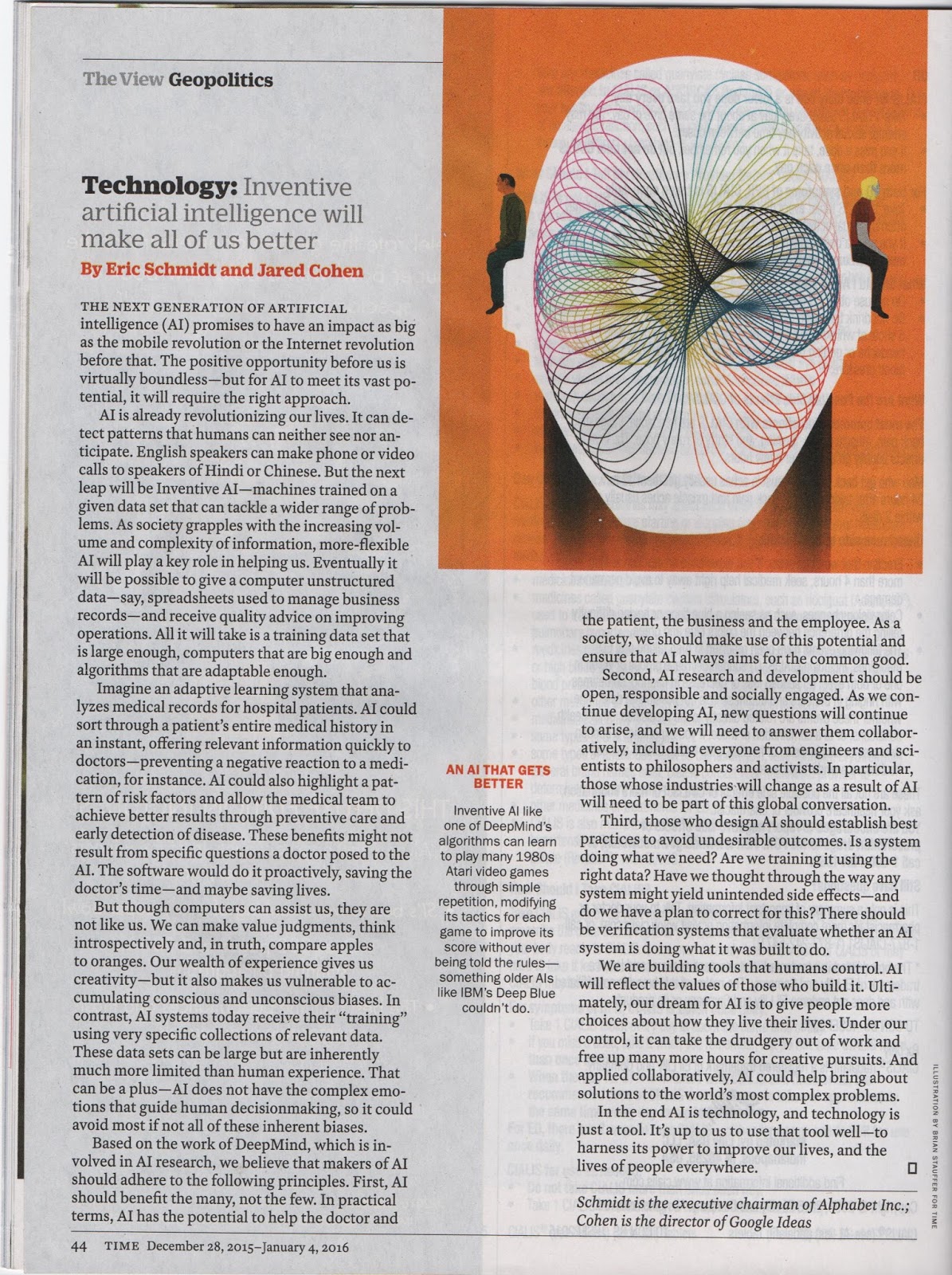
Here is an article I found in my Time Magazine about AI
December 24, 2015-January 4, 2016
Pg. 44

Progress Presentation

Here is my progress presentation.

Monday, January 4, 2016

Perceptron Algorithm Notes

Introduction

  • Perceptron models a neuron
  • n inputs are received by it that correspond to features
  • It takes the inputs and sums them, then produces an output after checking the result
  • Its main use is to classify groups that are linearly separable
  • It is often used for binary classification
Components
  • It is composed of a summation processor, and activation function (does the thresholding) and weights.
  • It takes a weighted sum of the inputs and outputs 
    • e.g. 1 if the sum is greater than the threshold and 0 if it isn't
    • Usually the input and output weights are real numbers
  • Perceptron can also have an input called the bias
    • Bias allows the transfer function curve to be shifted horizontally along the input axis while the curve is left unaltered.
  • Weight determines the slope 
    • e.g. in the eq. y = mx + b, m is the weight and b is the bias
  • Activation Function
    • Also know as transfer function
    • It translates input signals into output signals 
    • The output is produced using a threshold
    • The 4 types of activation functions most commonly used are: Unit step, sigmoid, piecewise linear, and Gaussian
      • The unit step is a simple threshold where the output is 1 of 2 levels and it depends on whether the input is greater than or less than the threshold value
      • The sigmoid contains 2 functions: tangential and logistic. Values of tangential functions are from -1 to 1 and the values of logistic functions are from 0 to 1.
      • In the piecewise linear function the output arrived at from being proportional to the total weighted output.
      • The Gaussian functions are continuous bell shaped curved functions. The node output which is high or low is interpreted from class membership which is 1 or 0, and depends on how close the net input is to a chosen value or average. 
  • Learning Rate
    • Used when updating the weights and bias to get a smaller error
    • Helps control how much the weights and bias are changed
  • Learning In Perceptrons 
    • when trying to find a line to separate two classes or groups it responds to the input vectors with a target value of 0 or 1
    • If the classes can be separated the solution will be found in a finite amount of time.

Thursday, December 31, 2015

Happy New Year!

Happy New Year! How was your winter break so far? Have you got some fun and got the chance to look into our first project? I just finished my first phase of study in Artificial Neural Network (ANN), and here is my note in PowerPoint form. You can use it to help you understand the basics. My next phase is to work on the Perceptron. If you had made some progress, feel free to share with us by posting your results in the blog. We will find time to meet as a group in the new year.

Wednesday, December 30, 2015

Ted Talk (implications of computers that can learn):

 Arthur Samuel was the “father” of machine learning because in 1956 he wanted to get a computer to beat him at checkers. He had computer play against itself and learn through thousands of times. In the end it worked.

 There is such a thing as a machine learning practitioner. Google shows it is possible to find information using a computer algorithm. This algorithm uses machine learning. Amazon, netflix use machine learning to suggest products. Rather than being programed by hand, algorithms learned how to do this from data.

 Self driving cars are possible because of machine learning. The self driving car has driven a million miles without any accident. Deep learning is an algorithm inspired by how the human brain works. Theoretically, there are no limitations to what it can do. The more data and computation time it has, the better it gets.

 Computers can listen and understand. They can also see. There is a 6 percent error rate in image recognition in computers. More complex sentences are understandable because of deep learning. Nuanced sentences are understandable. Computers can recognize what sentences are about. Computers can also write. They can describe images without having seen them in that order before. Deep learning can cut a lot of time from tasks.

Thursday, December 10, 2015

Machine Learning Project 1: Perceptron

In our first task, we are going to learn and implement a basic neural network - "perceptron". In machine learning, the perceptron is an algorithm for supervised learning. It is a type of linear classifier which can classify linearly separable data. The following links give you a starting point to study perceptron. You are more than welcome to share any resource you found online with us.

Tutorials:
Goals:
  • Understand the basic operation of Perceptron
  • Backpropagation
  • Learning rules of Perceptron
  • Limitations of Perceptron
  • Implement a Single-Layer Perceptron (SLP)
  • Real-world applications of Perceptron
  • Implement a Multi-Layer Perceptron (MLP)
Target Dates:
  • Study Phase: 12/10/2015 - 12/23/2015
  • Implementation Phase: 12/24/2015 - 01/03/2015
  • Seminar: 01/08/2015

Sunday, December 6, 2015

Deep Learning and Big Data

Machine Learning is no longer a fancy si-fi dream or an obscure research field in the dark corner of the ivory tower. It is current a highly competitive research field for both academia and industry. Industry giants such as Google, Facebook, and Baidu have acquired most of the dominant players in this space to improve their services. Small start-ups also try eagerly to find a niche in this new domain. Watch a video of a panel discussion about "Deep Learning: Intelligence from Big Data". hosted by a talented speaker venture capitalist Steve Jurvetson. The discussion was located at Stanford Graduate School of Business on September 16, 2014.


Welcom to Machine Learning! ..... Schedule Our Kick-off Meeting

Welcome to the Machine Learning Research Group! So far, we have 11 students (both sophomores & juniors) joining the group. The goals of the group are to tap into the cutting-edge academic & commercial resources of Artificial Intelligence (AI), follow up the development & trends of the new technologies, acquire the theoretical background and practical skills of machine learning, and apply machine learning algorithms to solve real-world problems.

Most of the early-stage research activities will be focusing on the learning curve of this new technology. It will include 
  • basic concepts (definition, background, scope, structure, methods & applications)
  • neural networks and learning algorithms,
  • programming languages & machine learning libraries, and
  • brainstorming the potential applications.

The second-stage research activities will be focusing on a few challenging research projects . We will divide our group into a few teams to tackle each challenge. These projects may lead to competitions (such as Google Science Fair), poster presentations in professional conferences (such as IEEE ISEC), publishing of research papers in research journals (such as NHSJS), class projects in Advanced STEM Research (see current STEM course blog), filing patents or commercial applications. Only sky will be the limit!
Most of our "meetings" will be online through the blogs or any electronic media. That's why I have invited all of the group members to be the authors of the Machine Learning blog (http://stem-ml.blogspot.com/). You should contribute to the blog frequently by posting and commenting on new development, video links, programming tutorials, study notes, and research results. You should also visit the blog frequently for information, activities or assignments. The blog will be our main playground for collaboration. If you haven't received the invitation, please let me know as soon as possible. We will also arrange some "meet-up time" at school at everyone's convenience. For our first "kick-off meeting", please use the link to indicate your available time slots. Please response by 8:00  PM (12/06/2015) tonight. If it's hard to find common meeting time for everyone, we will try to meet in subgroups.

In order for our research group to be productive, we will create a few assignments and set some milestones to help everyone pick up the new skills. The first assignment will be about a simple neural network called "Perceptron". The details will be coming soon. In the mean time, please enjoy the videos I have posted in our blog, and share your thoughts or post your notes. These videos will provide you the basic concepts of machine learning. If you come across any good video, please share with us. I hope to meet you all in our kick-off meeting! 

Happy Researching!

Thursday, December 3, 2015

What Neural Network Can Do for You?

There are growing number of applications in the machine learning field. Here is one of the video: writes sentence about images. While you are learning more and more about the machine learning applications, you can start thinking  about your own applications. What can neural network do for you? What can machine learning change certain aspects of your life? Share with us your ideas!

Friday, November 27, 2015

Deep Learning

In machine learning field, "Deep Learning" algorithm is probably the most heard term in recent years. It has been highlighted as one of the most promising technologies by many scientists. In the computer vision area, it has out performed many traditional computer vision techniques. We are going to get familiar with many new vocabularies and concepts by watching some well presented video tutorials. Here is a short one explaining to you "How does deep learning work?" Enjoy it!

Tuesday, November 24, 2015

Artificial Neural Network

In machine learning, the Artificial Neural Network (ANN) plays an important role. Though fully understanding the human brain is still the holy grail in the scientific community, it does not stop people from creating brain-like structures, and emulating/simulating the brain to perform brain-like functions. There are many different Neural Network (NN) architectures had been proposed and investigated over the past few decades, and many of them had found their applications in specific real-world problems. Watch the following TEDx Talks video to see how a teenage girl used a neural network to solve a
challenging real-world problem. 

Monday, November 23, 2015

Machine Learning

Machine learning is a branch of artificial intelligence (AI). It is the science of getting computers to act without being explicitly programmed. Computers will automatically learn and improve with experience. In the past two decades, machine learning has gradually changed our lives, and given us self-driving cars, practical speech recognition, effective web search, and a vastly improved understanding of the human genome. Machine learning algorithms have potential to create computers which can out-perform human in many areas. It is not only a new technology, it has potential to impact human society in a revolutionary way. Please watch the TED Talks video from data scientist Jeremy Howard, and welcome to the age of machine learning!